
DEXA vs. BIA: Which One Should You Use to Track Bone Health in Your 60s?
By Yordan Delchev, Senior Physiotherapist, MSc Sport & Exercise Medicine
If you’ve been told your bone density needs attention — or you’re simply being proactive about healthy ageing — you’ve likely come across two names: DEXA and BIA. Both are used to assess body composition, and both have a role in managing bone and muscle health. But they measure very different things, and understanding the distinction could genuinely change how you approach your health in your 60s and beyond.
What is DEXA?
DEXA (Dual-Energy X-ray Absorptiometry) is the clinical gold standard for measuring bone mineral density (BMD). It uses two low-dose X-ray beams to assess the density of bone tissue — most commonly at the lumbar spine and hip, which are the sites most vulnerable to osteoporotic fracture.
A DEXA scan produces a T-score, which compares your bone density to that of a healthy young adult. It’s the measurement your GP or consultant will use to diagnose osteopenia or osteoporosis, and to determine whether medication like bisphosphonates is warranted.
DEXA also provides a breakdown of lean mass and fat mass by body region — useful additional information, but not its primary purpose.
When DEXA is essential:
- You’ve received a diagnosis of osteoporosis or osteopenia
- You’ve had a fragility fracture (a break from a low-impact event)
- Your GP has referred you for a bone health assessment
- You’re on long-term corticosteroid medication
- You’re post-menopausal and want a baseline measurement
What is BIA?
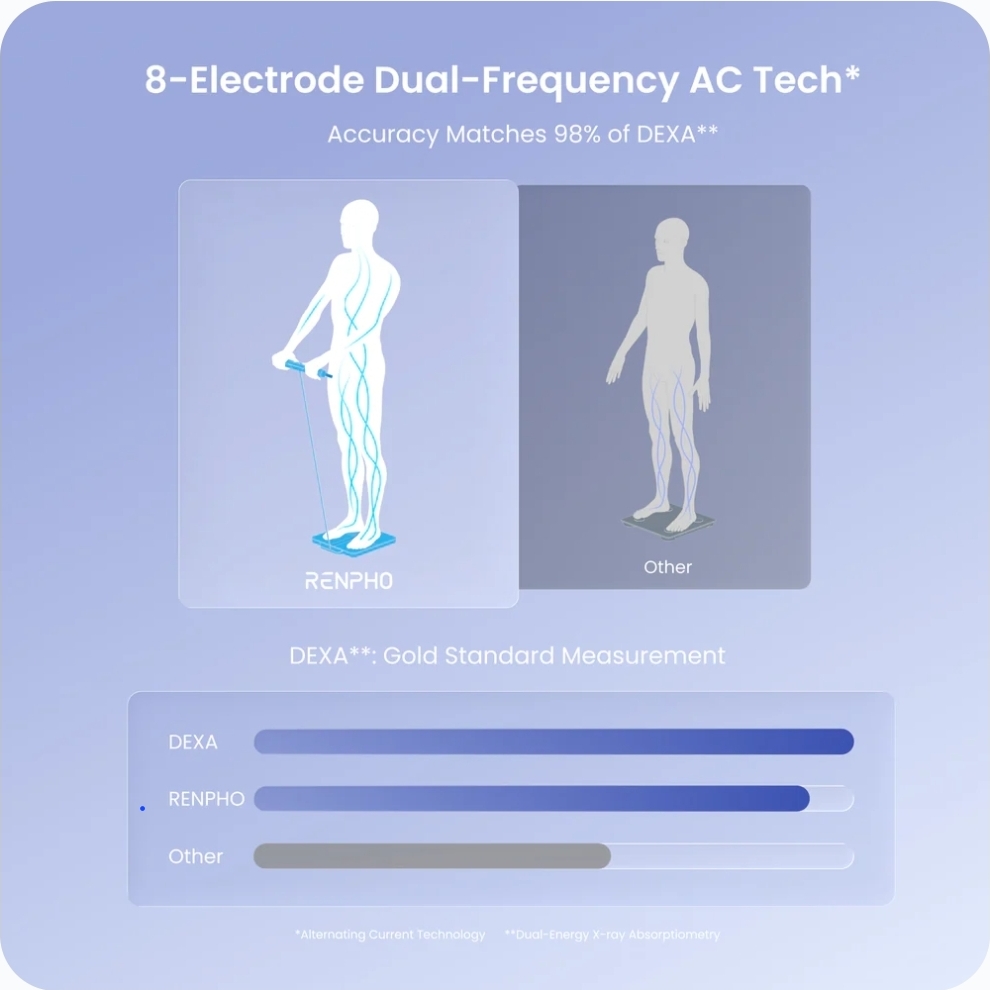
BIA (Bioelectrical Impedance Analysis) works on an entirely different principle. It passes a small, safe electrical current through the body and measures how it travels through different tissue types. Because muscle conducts electricity more readily than fat, BIA can estimate body composition — specifically muscle mass, fat mass, and body water.
Modern medical-grade BIA devices (including the one we use at Peak Physio) also estimate visceral fat, phase angle (a marker of cellular health), and skeletal muscle index — all of which are highly relevant to healthy ageing.
What BIA cannot do is measure bone density directly. It doesn’t produce a T-score and cannot diagnose osteoporosis.
Where BIA excels:
- Tracking changes in muscle mass over time — critical for detecting and monitoring sarcopenia
- Monitoring visceral fat, which is a key cardiovascular and metabolic risk marker
- Assessing hydration status and cellular health
- Frequent, low-cost monitoring (no radiation, no referral required)
- Evaluating the impact of an exercise or nutrition programme on body composition
The Key Distinction: Bone vs. Muscle
This is the most important point to understand. In your 60s, you’re typically managing two parallel risks:
- Bone loss (osteoporosis / osteopenia) — the weakening of bone tissue
- Muscle loss (sarcopenia) — the gradual decline in skeletal muscle mass that accelerates after 50
These two conditions often coexist, and together they dramatically increase the risk of falls and fractures. But they require different tools to assess.
DEXA tells you about your bones. BIA tells you about your muscles. For a complete picture of your musculoskeletal health in your 60s, you arguably need both.
A Practical Framework
| DEXA | BIA | |
|---|---|---|
| Measures | Bone mineral density | Muscle, fat, hydration |
| Diagnoses | Osteoporosis / osteopenia | Sarcopenia risk |
| Frequency | Every 1–2 years (clinical) | Every 8–12 weeks (monitoring) |
| Radiation | Low dose | None |
| Availability | Hospital / clinic referral | Available at Peak Physio |
| Cost | Via GP / health insurance | Included in our longevity assessments |
Our Recommendation
If you haven’t had a DEXA scan and you’re in your 60s — particularly if you’re female, post-menopausal, or have risk factors for osteoporosis — speak to your GP about a referral. It’s the only way to get a definitive picture of your bone density, and many people don’t know they have significant bone loss until a fracture occurs.
At Peak Physio, we use medical-grade BIA as part of our Osteoporosis assessments to monitor muscle mass, track body composition changes, and guide your exercise programme over time. It’s a fast, painless, and highly informative tool — and when used alongside DEXA data, it gives us a genuinely comprehensive view of how your body is ageing.
The goal isn’t just avoiding fractures. It’s building a body that stays strong, resilient, and capable — for as long as possible.
Interested in a body composition assessment or Osteoporosis consultation? Book online at peakphysio.ie or call us to speak with Yordan directly.