
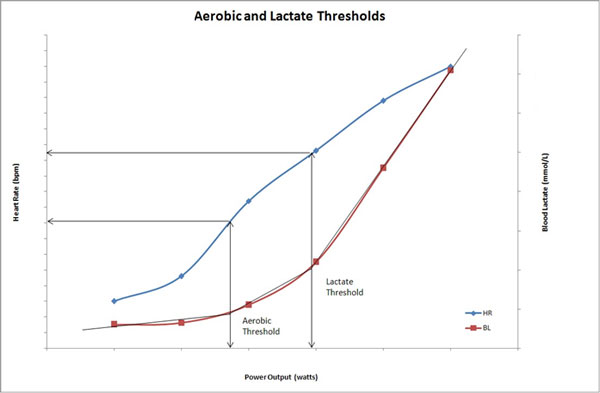
The graph above represents the power output, which can also be thought of as the intensity of an activity (x-axis), with regard to the corresponding heart rate (left axis) and lactate produced (right axis).
What is evident from this graph is that as the intensity of the activity increases, your heart rate increases. Not so ground breaking! What also happens is that your blood lactate also increases. Now this is important as excessive accumulation of lactic acid causes the pH in the body to drop and fatigue to set in. This will reduce that capacity of a muscle to contract and an increase in lactic acid stimulates the respiratory system, typical of when you notice yourself ‘blowing’ during a run.
What is good about this is the ability of the body to ‘train’ it’s response to exercise.
Taking the red curve above, we see that at a certain point (lactate threshold), the curve starts to take a steep incline. This represents an intensity of exercise at which lactate is rapidly being produced. This lactate production can only be sustained for a certain length of time before muscle fatigue becomes too great.
What is useful for us to use, is the corresponding heart rate associated with the lactate levels in your blood as this can be more easily monitored when you are running (as opposed to checking your blood lactate levels during a run). This allows us to monitor our estimated position on the lactate curve as we run.
Why is this useful? Well, depending on where you are on the curve on your runs, you will be training your body to adapt in different ways. I will speak more about this further down.
Another useful piece of information to merge with the training zones, is that of fuel utilisation. Put simply, for a sprint or short maximal exertion we’ll use stored ATP energy. When the body wants to utilise energy FAST for high intensity over a more sustained period it will utilise carbohydrate, both stored in the muscle and in the blood. The issue with this is that there is a limit to the amount of carbohydrate the body care store. When the body undertakes low-intensity exercise it can avail of the energy stored as fat. This energy is useful as there is typically a high abundance of it. In this day and age, we tend to be carbohydrate-centred and our bodies are primed to look for carbs for their fuel source. What we can try and do here, is to improve our aerobic fitness so the same intensity of exercise seems easier to us, thus allowing our bodies to utilise fat instead of carbs and keeping the carbs in storage in the muscle for when even greater exertion is demanded.
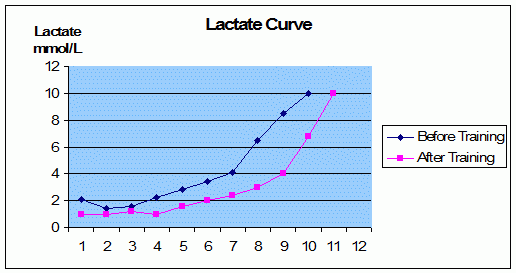
The graph above shows the effect that your training will have on the amount/intensity of exercise you can do, prior to lactate threshold being reached.
The way you can train for this is by roughly calculating your lactate threshold and training in a number of zones below this value. It is important to train in different zones to allow for recovery after your runs and also to try and increase your activity just prior to the threshold. For example, Zone 1 may be 50-60% of your maximum heart rate, Zone 2 60-70% of your max heart rate, Zone 3 70-80% of your max heart rate. Above roughly 85% of your max heart rate, the exercise becomes anaerobic and you are no longer specifically improving your aerobic fitness.
It is also important to train above your lactate threshold obviously, to reduce injury etc. but that’s a different topic. Training above your lactate threshold is also important to build up your tolerance to high levels of lactate in your body. When your lactate threshold has improved, it will allow you to run for longer in the future before you hit your wall, and will also allow you to recover from high intensity bout of exercise quicker, allowing you to do more repetitions of sprints etc. if you wish.
The best way to calculate your lactate threshold is by getting a lactate test, but you can roughly calculate your training zones by estimating your max heart rate (220 minus your age) and then working in various zones through the week.
An example of this would be:
Runner aged 40
Max heart rate: 220 – 40 = 180.
Training Zone 1 50-60% (recovery) = 90 – 108 beats per minute
Training Zone 2 60-70% (endurance) = 108 – 126 Bpm
Training Zone 3 70-80% (stamina) = 126 – 143 Bpm
Running would last between 45-90 minutes (preferably more towards 90 minutes), on a stomach not full to the tilt with carbs (to encourage fat storage utilisation), 5 – 6 times a week.
Your training may want to look something like
Day 1: Zone 2
Day 2: Zone 3
Day 3: Zone 1
Day 4: Zone 3
Day 5: Zone 2
Day 6: Zone 3
Day 7: Rest.
This is just a mock up, your runs and training may benefit from variations of this depending on your aerobic fitness and time to recovery etc.
Running may seem MUCH slower than normal, this is fine. Normally a course of 6 weeks training like this will see good improvement.
Disclaimer: ALWAYS check with a suitable medical professional if you are OK to begin exercise.